
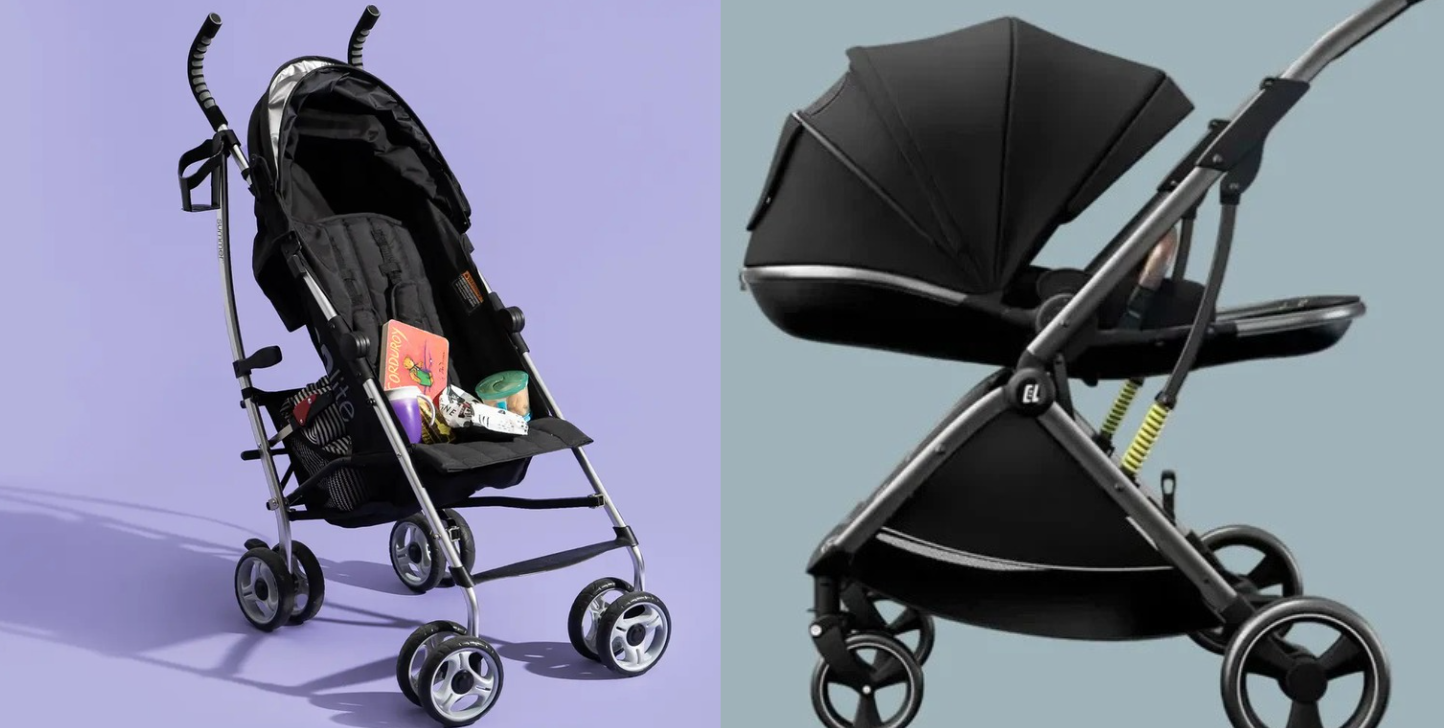
An umbrella stroller is the lightweight, narrow-folding stroller you toss in the trunk for errands, flights and park trips. It won’t replace a full-size stroller for every family, but in the right situation it’s one of the most useful pieces of baby gear. This guide covers when it makes sense, which features matter, and what to check for safety.
What Is an Umbrella Stroller?
An umbrella stroller is a compact stroller with a simple frame that folds long and slim, like a closed umbrella. Most weigh roughly 8 to 15 lb (about 3.5 to 7 kg), compared with 20 to 30 lb or more for many full-size models. The trade-off is fewer features: smaller wheels, a smaller basket and a simpler seat.
When Does an Umbrella Stroller Make Sense?
- Toddlers who tire quickly. A child who walks happily for ten minutes and then refuses to take another step is the classic use case.
- Travel. Airports, taxis, hotels and busy attractions are easier with a stroller you can fold quickly.
- A second stroller. Many families keep a full-size stroller for daily walks and an umbrella stroller in the car for quick trips.
Age matters. Most umbrella strollers are designed for babies who can sit up unassisted and hold their head steady, often around 6 months and older, though some models have higher minimums. Always check the age, weight and height limits in your model’s manual.
Features That Matter
Weight. A light frame makes loading the car and carrying it up stairs much easier. Don’t pick the lightest one automatically, though. It should still feel stable when you push it.
Fold. Look for a quick, simple fold with an automatic lock. A stroller that stands on its own when folded is a bonus. Since you’ll fold it constantly, this matters more than most buyers expect.
Seat and recline. Check the padding and how much room your child has. If your child naps on outings, a reclining seat is close to essential, and many basic umbrella strollers barely recline at all.
Canopy. A small flap offers little real protection. Look for a canopy that extends well past your child’s face, ideally with UPF-rated fabric.
Wheels and brakes. Small wheels struggle on gravel, cracked pavement and curbs. Test the brake to make sure it engages easily and holds firmly.
Storage. A small basket is usually enough for water, snacks and a light jacket. Check its weight limit and don’t overload it.
Harness. A 5-point harness keeps your child secure and is the safer choice.
Umbrella Stroller vs Full-Size Stroller
| Umbrella Stroller | Full-Size Stroller | |
|---|---|---|
| Weight | Light | Heavier |
| Folded size | Slim and compact | Bulky |
| Storage | Minimal | Large basket |
| Wheels and suspension | Basic | Better on rough ground |
| Recline | Limited or partial | Often full recline |
| Best for | Travel, errands, car backup | Daily long walks, newborns |
If you walk long distances every day or need space for shopping, a full-size stroller is usually the better primary choice. For many parents, owning both makes sense: the full-size stays home for everyday use, and the umbrella stroller lives in the car.
Is an Umbrella Stroller Good for Travel?
Usually, yes. Airports involve a lot of walking, and young kids don’t always have the energy for it. A stroller that folds easily makes moving between the car, terminal, hotel and sightseeing spots far less stressful. In the US, most airlines let you check a stroller at the gate for free, and some very compact models fit in the overhead bin. Policies vary, so check your airline’s current rules and your stroller’s folded dimensions before you fly.
For road trips, a slim fold leaves more trunk space for luggage.
Umbrella Stroller Safety Checklist
- Use the harness every time.
- Engage the parking brake whenever you stop.
- Never leave a child unattended in a stroller.
- Don’t hang heavy bags on the handles unless the manufacturer allows it. Extra weight can make the stroller tip.
- Before each outing, check for loose parts, worn wheels, brakes that don’t engage, a frame that doesn’t lock securely, damaged straps and a folding mechanism that sticks.
- Look for compliance with your region’s safety standard (in the US, ASTM F833 and JPMA certification) and check your model for recalls at cpsc.gov.
- Keep your child’s fingers and limbs clear when folding or unfolding.
How to Choose the Right One
- Where will you use it most? Travel favors low weight and a compact fold. Neighborhood walks favor good wheels and seat comfort.
- How old and big is your child? Check the minimum age and the maximum weight and height.
- Does your child nap in it? If so, prioritize recline.
- How will you carry and store it? Compare the folded size with your trunk and closet space.
- Try it in a store if you can. Fold it, lift it and push it before you buy.
Skip models loaded with extras you won’t use. A simple stroller that folds easily and keeps your child comfortable is usually a better buy than an expensive one packed with features.
Final Thoughts
An umbrella stroller is about making life a little easier. It isn’t meant to do everything a full-size stroller does. For parents who want something lightweight for errands, vacations and quick outings, or a backup that stays in the car, it’s a practical choice. Check the safety requirements, make sure the seat suits your child, and think about where you’ll realistically use it. Do that, and picking a model gets much less overwhelming.
FAQs
What age can a child use an umbrella stroller?
It depends on the model. Many are suitable once a baby can sit unassisted with good head control, often around 6 months. Always follow the manufacturer’s age, height and weight limits.
Are umbrella strollers good for travel?
Yes, generally. Their light weight and compact fold suit airports, road trips and sightseeing. Confirm your airline’s rules first.
Can an umbrella stroller replace a full-size stroller?
Sometimes, for families who mostly drive and walk short distances. For daily long walks or newborns, a full-size stroller is usually better.
What matters most when buying one?
Safety certification, weight, fold, seat comfort and recline, canopy, brakes and wheels, storage, and the manufacturer’s age and weight limits.