
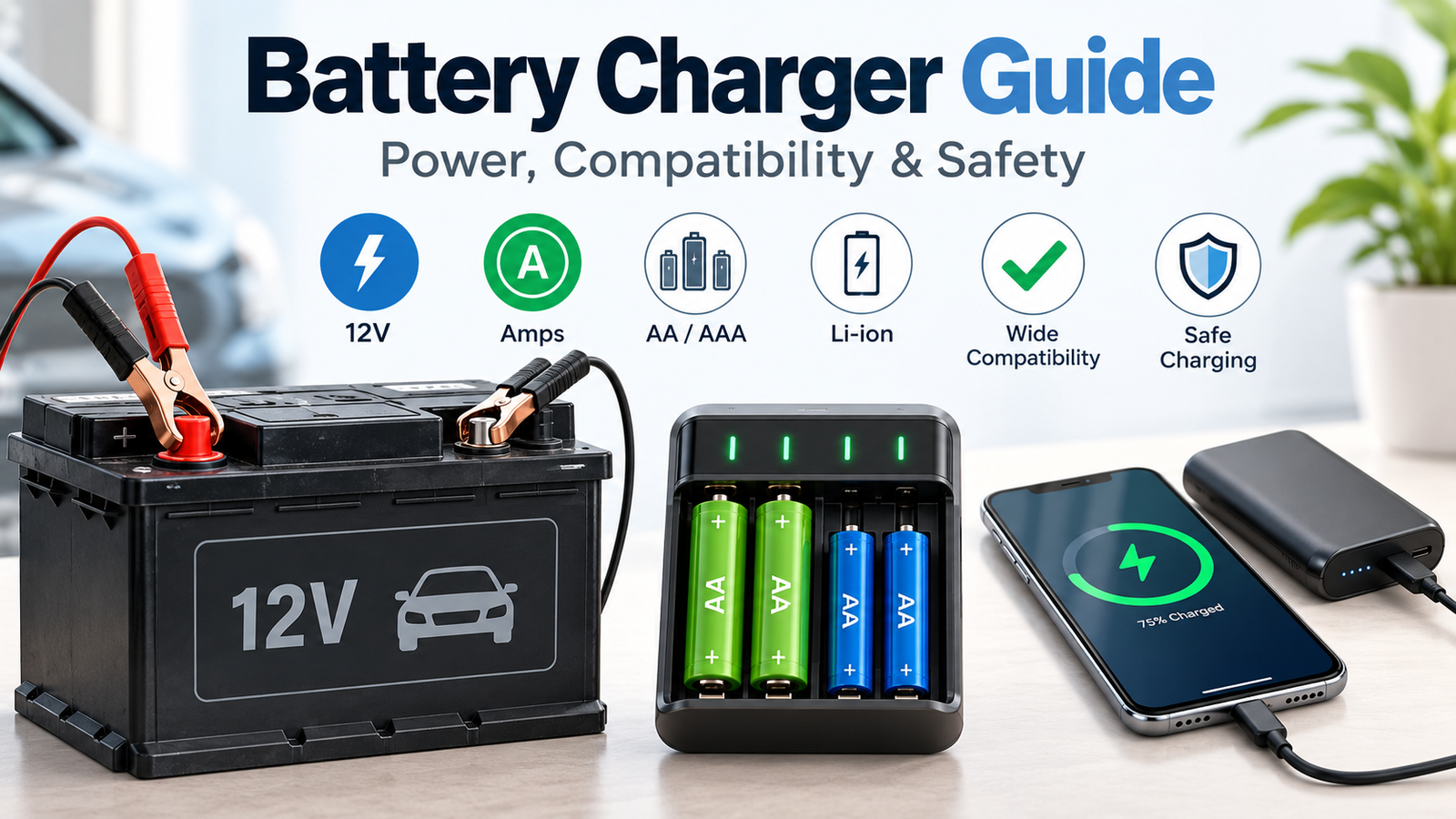
A battery charger looks simple until you try to buy one. Then you meet voltage, amps, chemistry, connectors and “smart” modes all at once. The main rule is that a charger must match the battery it is meant for. This guide explains the basic terms, the main charger types and the mistakes to avoid, so you can pick the right one with confidence.
What Does a Battery Charger Do?
A battery charger pushes electrical energy into a rechargeable battery, which stores it and releases it later to power a device or vehicle. The job is the same everywhere, but the method is not. A car battery, a cordless drill pack, a rechargeable AA cell and a phone battery each need a different charging approach. That is why you should start with the battery, not the charger.
Voltage and Amps Explained
Voltage is the electrical pressure the charger applies. It must suit the battery. For example, a standard car battery is 12V, a rechargeable AA cell is 1.2V, and a single lithium-ion cell is about 3.6 to 3.7V (charged up to 4.2V). Two batteries with similar-looking voltage numbers are not necessarily compatible, because chemistry and the manufacturer’s requirements matter too.
Amperage (amps) is how much current the charger can deliver. More amps can mean faster charging, but only if the battery is designed to accept it. For a lead-acid car battery, a common rule of thumb is a charge current of about 10% of its amp-hour (Ah) capacity, so a 50Ah battery charges comfortably at around 5A. Pushing much more current than recommended creates extra heat and can shorten battery life.
Types of Battery Chargers
Car battery chargers. These are built for 12V vehicle batteries. Some are for recharging a flat battery. Others are maintainers (sometimes called trickle chargers) that deliver a low current to keep a battery topped up in a car, boat or motorcycle that sits unused for weeks.
AA and AAA chargers. Rechargeable AA and AAA cells, usually NiMH, need a charger that supports their chemistry. These cells power cameras, toys, flashlights and remote controls. Never put regular non-rechargeable (alkaline) batteries in a charger meant for rechargeables.
Smart chargers. A smart charger monitors the battery while it charges, adjusts the current as the battery fills up, and often switches to a maintenance mode when it is full. It is a good choice if you charge often or don’t want to watch the process.
| Charger type | Typical use | Good to know |
|---|---|---|
| Basic car charger | Occasional recharge of a flat battery | Needs supervision; unplug when done |
| Maintainer / trickle charger | Cars, boats, motorcycles in storage | Low current, safe to leave connected |
| NiMH AA/AAA charger | Household devices | Must support NiMH; not for alkaline cells |
| Smart charger | Frequent or unattended charging | Adjusts automatically and stops at full |
Why Battery Chemistry Matters
Lithium-ion, lead-acid and nickel-metal hydride (NiMH) batteries each charge differently. Lithium-ion packs use a controlled constant-current, then constant-voltage method with strict voltage limits. Lead-acid batteries need a multi-stage profile and good ventilation. NiMH cells need their own cutoff detection. A charger built for one chemistry should not be used on another, even if the voltage looks right.
Before buying a replacement charger, read the battery label and the manufacturer’s specs. If the battery came with an original charger, check that charger’s output rating too.
How to Choose the Right Charger
- Identify the battery. Note the voltage, chemistry and capacity (Ah or mAh) printed on the label.
- Match the charger to those specs. Look for a charger that explicitly lists your battery type and voltage, not one that is merely “close enough.”
- Check the connector. Some batteries use standard plugs, while others use proprietary connectors that only work with specific chargers.
- Think about how you will use it. Occasional charging of a car battery needs little. Daily charging of tool batteries benefits from a smart charger.
- Look for safety certification. Marks such as UL, ETL or CE show the charger has been tested to a recognized safety standard.
Does Faster Charging Mean Better Charging?
Not necessarily. Fast charging is convenient when you need a battery ready quickly, but the battery must be built to accept that rate. Forcing in more current just to save time creates heat, and heat wears batteries out faster. The goal is appropriate charging, not the fastest charging.
Battery Charger Safety
- Use only a charger designed for your battery type and voltage.
- Inspect the battery, cable, plug and connectors before each use. Do not charge anything with a damaged cable, cracked casing or a swollen battery.
- Keep chargers away from water unless they are rated for it.
- Charge lead-acid car batteries in a well-ventilated area, since they can release hydrogen gas.
- Don’t cover a charger or place it where airflow is blocked.
- Unplug the charger before connecting or disconnecting clamps, and follow the instructions in the manual.
- If a battery gets very hot, swells, leaks or smells unusual, stop charging, unplug it, and follow the manufacturer’s safety guidance. Swollen lithium-ion batteries should be disposed of at a proper battery recycling point.
Common Mistakes
- Choosing a charger because the connector fits. A plug that fits physically can still be electrically wrong.
- Choosing purely on speed. Faster is not always better for the battery.
- Ignoring warning signs. Heat, swelling or odd smells mean stop.
- Skipping the manual. Charging time, mode settings and ventilation advice are all in there.
- Buying the cheapest option. A cheap charger that doesn’t properly support your battery costs more in the end.
Getting More Life From Your Charger
Avoid sharp bends or crushing in the cable, store the charger somewhere dry, and keep the connectors clean. If you own several similar-looking chargers, label them so you don’t grab the wrong one. It also helps to keep a note or photo of each battery’s specs so you can find a correct replacement later without guessing.
Final Thoughts
Choosing a battery charger comes down to compatibility. Check the voltage, chemistry, capacity, connector and recommended charging method, then decide between a basic and a smart model. Don’t buy based only on power or speed claims. The right charger is the one designed to work safely with your specific battery, and a few minutes spent reading the specs can save you from damaged equipment and wasted money.
FAQs
Can I use a higher-voltage charger on my battery?
No. Always match the charger’s voltage to what the battery requires. The wrong voltage can damage the battery or create a safety risk.
Does a faster charger damage batteries?
It can, if the battery isn’t designed for that charging rate. Use a charger rated for your specific battery type and capacity.
How do I know if my charger and battery are compatible?
Check the battery’s voltage, chemistry and capacity on its label, then compare them with the charger’s output rating and supported battery types.
Can I leave a battery on the charger overnight?
Only with a charger that has automatic shut-off or a maintenance mode, such as a smart charger. With a basic charger, unplug the battery once it is full.