
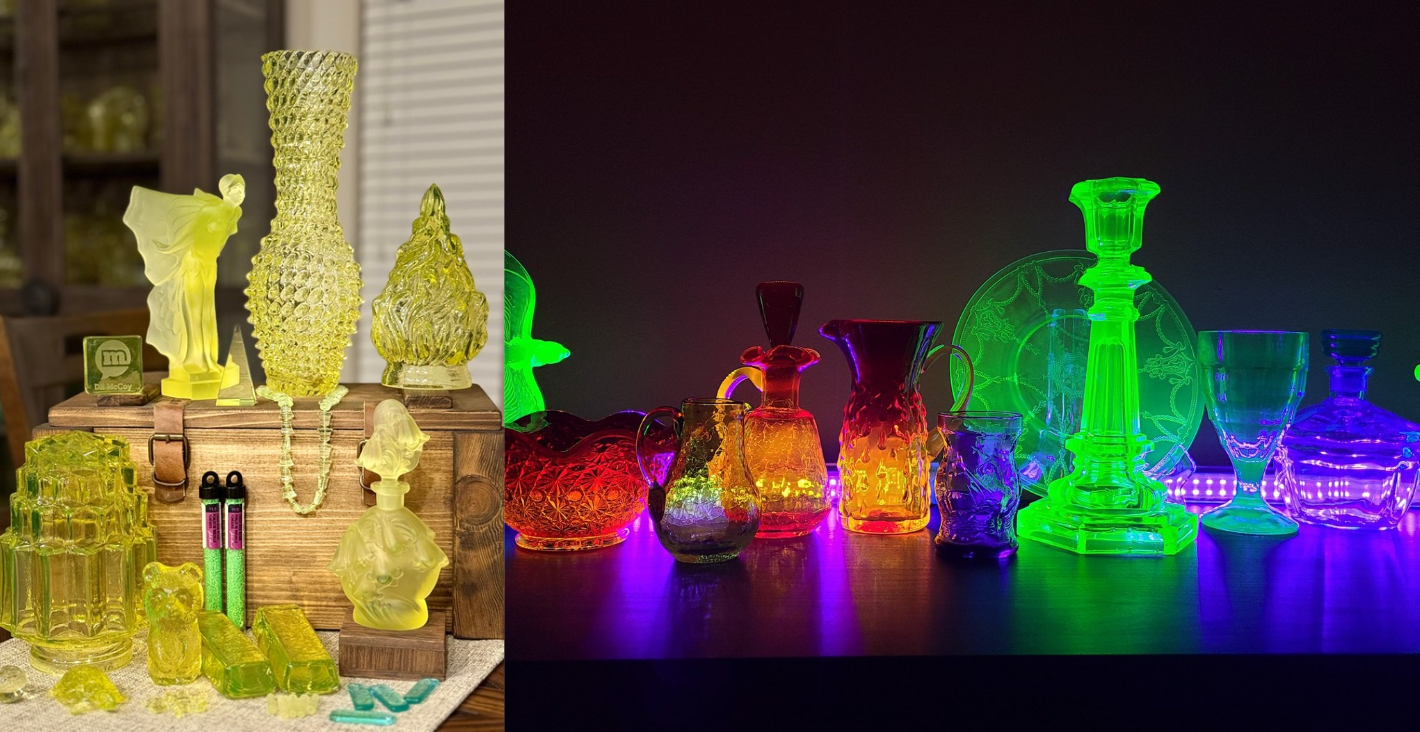
Under normal room light, a uranium glass bowl is easy to walk past. Pale green, a bit old-fashioned, nothing special. Then someone holds a UV torch over it and the whole thing lights up neon green. That’s the moment most collectors get hooked.
If you’ve just come across a piece, you probably have three questions. What is it? Why does it glow? Can it stay on your shelf? Let’s take them one at a time.
What it actually is
Glassmakers mixed a small amount of uranium compound into the glass. They did it for colour. Nobody was after radioactivity, the uranium simply gave a nice shade.
Green is the famous one, but yellow and amber exist too, plus a few others depending on the recipe.
The glow
Here’s the thing people get wrong: the glass doesn’t glow on its own. Put it in a dark cupboard and it’s just dark. You need UV light, and when UV hits the uranium, the glass fluoresces. That’s the whole trick.
How bright? It varies. The amount of uranium matters, so does the glass formula, and so does your torch. Two pieces side by side can look quite different.
Where it came from
Uranium was colouring glass way before collectors cared. In the 1800s and early 1900s you could find it in tableware, vases and little ornaments in ordinary homes.
World War II changed that. Uranium became tightly controlled and was wanted for other uses, so everyday glassmaking mostly stopped using it. Which is a big reason older pieces are the ones people hunt for now.
Types you’ll run into
Green uranium glass is the classic, anywhere from soft pale green to a stronger yellow-green. Most glow well.
Vaseline glass is yellowish and slightly see-through. Careful with the name though, because sellers use it loosely. Plenty of “Vaseline glass” has no uranium at all, so test it.
Custard glass looks creamy and opaque. Some older pieces contain uranium and glow strongly.
Depression-era glass is the cheap, mass-produced stuff from that period. Some of it used uranium, so old plates, cups, bowls and serving dishes can turn up with a glow.
Checking a piece
UV torch first. A strong green glow is a good clue.
Just don’t treat it as proof. Other materials fluoresce as well, so glowing doesn’t automatically mean uranium. Age, colour, pattern and maker’s marks help fill in the picture. If the piece is worth real money, or you need a firm answer, pay for professional testing.
So, is it safe?
It’s mildly radioactive, yes, because uranium is in the glass. For typical household pieces the level is generally low.
Use common sense. Keep pieces in good shape, don’t grind or damage them, and wash your hands after handling old items, especially dusty or chipped ones.
Eating and drinking from it is another matter. These are old objects, and their make-up and condition can vary. Most collectors just display them. I’d do the same.
Got a damaged piece, or one that worries you? Get it checked by someone who can measure radiation properly.
Showing it off
A glass cabinet or sturdy shelf works well. Keep antiques away from edges where they can get knocked.
If you buy a UV light for display, get a proper one and never stare straight into it. In daylight it’s a vintage vase. Under UV it looks like it’s plugged into the wall.
Why collectors love it
Some people like the history. Others like old glassmaking methods. Plenty just want the glow.
Price depends on age, maker, rarity, condition, colour, design and current demand. A plain piece can be cheap. A rare, well-kept one costs more. Before you get excited about a find, look up the specific maker and pattern.
FAQs
Is uranium glass actually radioactive?
Yes, it contains uranium compounds. Typical pieces have fairly low levels.
Why does it glow green?
Uranium compounds fluoresce under UV light, giving that green or yellow-green glow.
Can I use it for food?
Many collectors only display it. Old pieces vary in condition and composition, so decorative use is the cautious choice.
How do I know if glass has uranium?
UV light gives a good clue. For a definite answer, get it tested professionally.
Is it valuable?
Sometimes. Many pieces are cheap, and value depends on rarity, condition, age, maker and demand.