
Airlines have tightened their baggage rules in recent years. The space above your head is now a paid upgrade on many flights. Basic economy tickets on United, Spirit, or Frontier do not include an overhead bin. You only get one free personal item.
Passengers with standard rolling suitcases get stopped at the gate. Gate agents charge steep penalty fees to check them into the cargo hold. That is why travelers now rely on underseat luggage.
An underseat bag counts as your free personal item on almost every airline. You can walk right past the check-in counters. You do not have to pay extra fees at the boarding gate. Best of all, you can leave the airport immediately after landing without waiting at the baggage carousel.
However, traveling out of a single personal item requires careful planning. A bag that looks small in a store might fail the airline sizer box. Protruding wheels, stiff handles, and overstuffed front pockets can cause problems. You need to know real airline dimensions, the difference between wheel styles, and how to pack for a short trip.
What Counts as Underseat Luggage?
The In-Flight Storage Rule
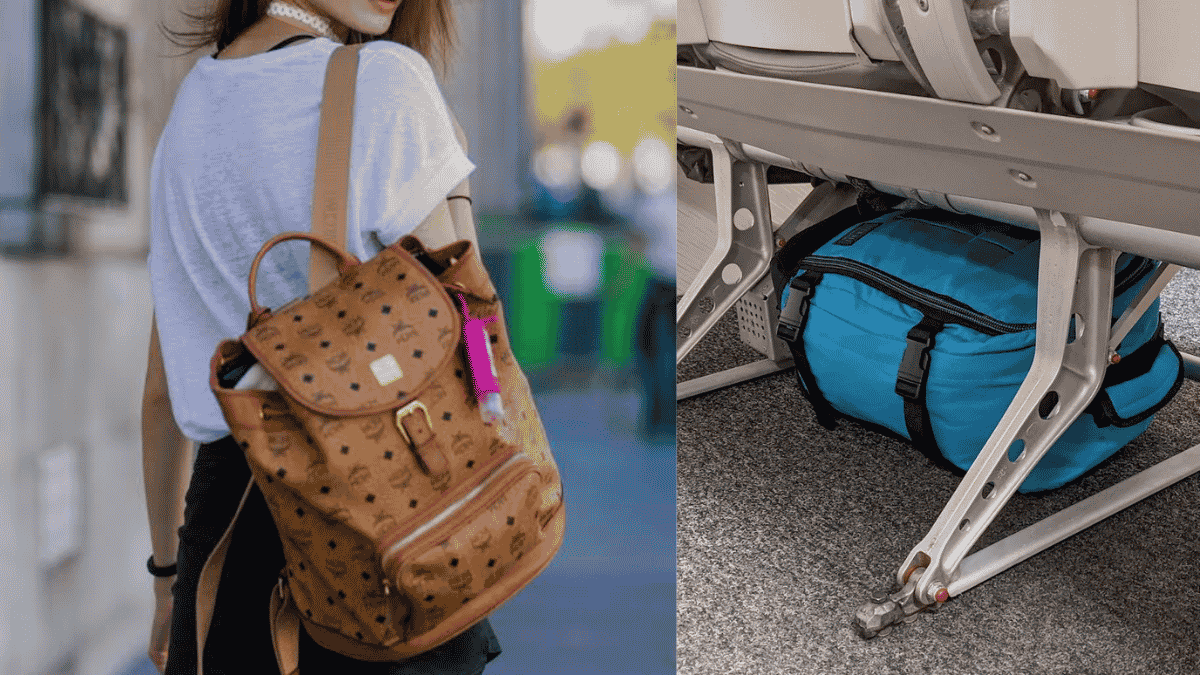
A personal item is defined by where it sits during flight. A standard carry-on suitcase rides wheels-first in an overhead locker. Your personal item must rest completely under the seat in front of you. It holds items you need during the flight, like a laptop, medicine, and headphones.
Airlines enforce strict boundaries on this floor area. Flight attendants walk the aisles during taxi, takeoff, and landing. They check that bags do not stick out into your legroom or the aisle walkway. An oversized bag creates an evacuation hazard under safety rules. If your bag does not fit, the crew will make you gate-check it into the cargo hold.
Permitted Styles
Common personal items include small backpacks under 28 liters, soft duffels, and rolling totes. Standard 22-inch rolling suitcases never qualify as personal items. Their frame length is simply too long for the physical depth of airplane seating rows.
Underseat Luggage Size by Airline
Every airline sets its own personal item dimensions. Budget airlines enforce these limits aggressively. They view oversized bags as a quick source of fee revenue. Legacy carriers are slightly more relaxed, but they still check bags on fully booked flights.
American Airlines and Delta Air Lines
American Airlines sets its personal item limit at 18 x 14 x 8 inches. This is one of the most generous allowances among domestic carriers. You have enough room for several outfits, flat shoes, and a laptop. Most soft-sided rolling totes and travel backpacks fit easily within these dimensions.
Delta Air Lines does not publish exact inch measurements on its website. Delta rules simply state that the bag must fit under the seat in front of you. In practice, aiming for 17 x 13 x 9 inches keeps you safe on all Delta flights. That includes their smaller regional commuter planes.
United Airlines Basic Economy
United Airlines enforces one of the narrowest personal item rules at 17 x 10 x 9 inches. That ten-inch width limit catches many travelers off guard. Most standard rolling totes measure between thirteen and fourteen inches wide.
Gate agents frequently make basic economy passengers test their bags in the metal sizer box. If your bag cannot slide down into that ten-inch slot, you must pay a fee. You will pay the standard checked bag fee plus an extra gate-handling charge before boarding.
Southwest Airlines
Southwest remains the most generous major airline in the United States. Every ticket includes two free checked bags and one free overhead carry-on. Because bin space is not contested, gate staff rarely checks personal items. Southwest lists its personal item limit at 18.5 x 13.5 x 8.5 inches. You will have plenty of room for a thick backpack or rolling bag.
Spirit Airlines and Frontier Airlines
Spirit and Frontier both cap personal items at 18 x 14 x 8 inches. These carriers rely heavily on baggage fees. Their gate staff is trained to spot bags that look even slightly too large.
Their airport sizers have solid steel sides with zero flex. If your bag bulges or the wheels stick out, it will snag on the sizer rim. Gate agents will charge you up to ninety-nine dollars on the spot before letting you board.
European Budget Airlines
European airlines enforce much tighter limits than American carriers. Ryanair allows a free cabin bag of just 15.7 x 9.8 x 7.8 inches on basic tickets. EasyJet allows slightly more room at 17.7 x 14.1 x 7.8 inches. British Airways allows up to 16 x 12 x 6 inches.
Always measure your bag at home while it is packed full of gear. A soft fabric bag that measures eight inches empty will stretch out to ten inches when packed. Airport sizers only care about the final packed dimensions. Knowing your true underseat luggage size prevents costly surprises at the boarding gate.
Two-Wheel Rolling Bags vs. Four-Wheel Spinners
Rolling your bag through a huge terminal takes the strain off your back. But adding wheels to a small bag always reduces interior packing space.
Two-Wheel Rolling Bags
Two-wheel bags use inline skate wheels built into the bottom corners of the frame. These wheels are partially recessed into the suitcase body. Only a small curve of rubber sticks out past the fabric frame.
Because the wheels sit inside the frame, the bottom of the bag rides close to the floor. Almost the entire vertical height of the bag remains available for clothes. Two-wheel bags track straight behind you on airport concourses. They roll smoothly over thick carpet, sidewalk cracks, and curbs.
Best of all, recessed wheels rarely catch on the metal legs under the airplane seat. The only downside is that you must pull the bag behind you at an angle. That creates a slightly wider footprint when walking through crowded spaces.
Four-Wheel Spinner Bags
A spinner underseat luggage bag uses four wheels that rotate a full 360 degrees. You can keep the bag upright and glide it in any direction with a light push.
Spinners are very comfortable on flat airport terminal floors. All the bag weight rests on the floor instead of your wrist. You can also turn a spinner sideways and roll it straight down narrow airplane aisles without bumping into seats.
However, four-wheel spinners struggle as personal items. The four wheel assemblies stick out completely from the bottom of the suitcase frame. Those wheels add two to three inches of dead space to the exterior height.
Airlines measure bags from the bottom of the wheels to the top of the handle. Those three inches of wheel height directly reduce your clothing space inside the bag. Furthermore, exposed spinner wheels frequently snag on floor bolts and metal brackets under the passenger seat.
If your goal is packing the most clothing possible, a two-wheel underseat luggage with wheels is almost always the better choice.
Hidden Space Traps on the Plane
Even if your bag meets airline measurements, it can still get stuck under the seat. Aircraft cabins contain structural supports and electronics that change the floor space across different rows.
The Aisle Seat Problem
Many travelers pick aisle seats to get up easily during the flight. However, aisle seats usually have the smallest floor space on the plane. Airplane makers place the seat support posts closer together on the aisle side to maintain row strength. This design shaves about two inches of width off the floor space. A rolling bag that fits under a middle seat may not slide under an aisle seat in the same row.
In-Flight Entertainment Boxes
Older planes and widebody aircraft often have metal electronics boxes bolted to the floor under the seats. These boxes power the seatback video screens. They take up about one-third of the floor area, creating an awkward, narrow gap. A rigid rolling bag will not fit next to one of these hardware boxes.
Life Vests and Seat Rails
Some planes have hard plastic life vest boxes mounted under the seat bottom. This lowers the vertical clearance by an inch or two. In addition, the curved fuselage wall near window seats cuts into the floor angle.
The Middle Seat Advantage
The middle seat is the least popular spot on the plane, but it has the best floor space. The support legs are spaced wider apart in the center of the row. Airlines also rarely place electronics boxes under middle seats. If your bag is packed thick, the middle seat gives you the easiest fit.
Softside Fabric vs. Hardside Shells
The material of your bag plays a big role at the boarding gate.
Why Softside Nylon Works Best
Heavy-duty fabrics like ballistic nylon and polyester are ideal for underseat travel. A soft fabric bag has natural flexibility. If an airline sizer box is slightly tight, you can press down on the bag and squeeze it inside.
Under the seat, a soft bag bends around metal floor bolts and seat rails. Softside bags also feature outside zippered pockets. You can reach down during the flight and grab your headphones or charger without pulling the whole bag onto your lap.
The Problem with Hardside Shells
Rigid polycarbonate plastic suitcases look clean, but they are impractical under an airplane seat. A hard plastic shell has zero give. If an airport sizer box is slightly smaller than your suitcase frame, you cannot force it in.
Hardside bags also use a clamshell opening that splits down the middle into two halves. You must lay the bag flat across your knees to open it. That is nearly impossible to do in a cramped economy seat without hitting the person next to you.
Key Features in the Best Underseat Luggage
When shopping for the best underseat luggage for weekend trips, focus on practical hardware details rather than brand prestige.
A Wide Trolley Sleeve
A trolley sleeve is a wide fabric strap on the back of the bag. It lets you slide the bag over the handle of a larger rolling suitcase. If you travel with both a big suitcase and a personal item, this strap keeps your hands free.
A Dedicated Front Laptop Pocket
Airport security checkpoints require laptops to be removed from your bag. Look for an underseat bag with a padded computer pocket inside the front flap. You can slide your laptop out in seconds without opening your main clothing section.
Safe Charger and Battery Storage
Keeping your phone cords and backup power banks organized is critical on travel days. Federal aviation safety rules require all lithium-ion battery packs to remain in your carry-on luggage inside the passenger cabin. Loose lithium batteries are strictly banned from checked baggage because of fire risks.
Before packing your electronics, read our guide on battery chargers, power compatibility, and safety to make sure your wall plugs, voltage levels, and cords match your travel gear.
Recessed Telescoping Handles
The telescoping handle should collapse completely flush with the top of the bag. If the plastic grip sticks out past the fabric frame, gate agents count that extra height against your size limit.
Top Underseat Bag Options Compared
Different bags serve different travel needs. Here is how popular models compare in real travel conditions:
Travelpro Maxlite 5 Rolling Underseat Bag
The Travelpro Maxlite 5 is widely viewed as the best underseat luggage with wheels for domestic flying. It uses two inline skate wheels with low-profile housings, keeping the total height at 17.5 inches. The fabric has a water-resistant coating, and the interior includes hanging wet pockets for toiletries. It fits reliably on American, Delta, and Southwest flights.
Samsonite Underseat Spinner
The Samsonite Underseat Spinner offers full 360-degree mobility for travelers who prefer gliding their bag upright. It features an exterior USB housing connected to an interior battery pocket. However, because the spinner wheels extend from the bottom of the frame, the interior volume is smaller than two-wheel models. It works best for short overnight trips.
Calpak Hue Mini Carry-On
The Calpak Hue Mini is a compact, rigid hardshell spinner designed for hotel weekenders. It measures sixteen inches tall, features a sleek matte polycarbonate finish, and includes built-in TSA locks. It protects fragile gear well, but its rigid frame makes it risky for budget airlines with strict metal sizers.
Briggs & Riley Baseline Compact Rolling Tote
Built from heavy-duty ballistic nylon, the Briggs & Riley Baseline is an executive rolling bag designed for business travel. It features a flat interior packing area, dedicated document pockets, and smooth inline skate wheels. It carries a premium price, but it comes with an unconditional lifetime repair guarantee that covers airline damage.
How to Pack an Underseat Bag for Three Days
Fitting three days of clothes and toiletries into a 22-liter personal item requires simple packing rules:
Use compression packing cubes to squeeze air out of folded clothes. They reduce clothing bulk by nearly thirty percent, leaving room for shoes and toiletries.
Wear your heaviest clothes on the plane. Put on your thickest sneakers, jeans, and jacket on travel day. Pack only your light shirts and activewear inside the bag.
Limit your extra footwear. Shoes take up more room than any other item in your luggage. Wear one pair on your feet and pack at most one pair of flat sandals or slip-on loafers along the bottom rails of the bag.
Keep liquids in an outside pocket. Put your clear quart-sized liquids bag in the top exterior zipper so you can pull it out quickly at the security line.
Roll your garments instead of folding them. Rolling clothes tight like small logs prevents creases and lets you pack shirts side by side with zero wasted space.
Frequently Asked Questions
Can an underseat bag be my only luggage on a flight?
Yes. If you use compression packing cubes and avoid heavy extra shoes, an underseat bag easily holds clothes for two to three days. Many travelers fly with only an underseat bag to avoid paying carry-on fees on Basic Economy tickets.
What happens if my bag does not fit under the seat?
If the bag sticks out into the aisle walkway, flight attendants will tell you to move it to an overhead bin. If the overhead bins are completely full, the crew will gate-check your bag to the cargo hold. On budget airlines, gate staff may charge an oversized bag fee before boarding.
Are rolling underseat bags better than travel backpacks?
A rolling bag takes all weight off your shoulders, which helps during long airport walks. However, wheels and metal handle tubes add empty weight and take up interior packing space. A travel backpack has no wheels, holds more clothing, and fits into tight sizer boxes much easier.
Do airlines weigh personal items?
Major US airlines like American, Delta, United, and Southwest do not weigh personal items at the gate. As long as your bag fits within the size dimensions, the weight does not matter. However, European carriers like Ryanair regularly enforce combined cabin weight limits between 15 and 22 pounds. Always check your airline weight rules before flying abroad.